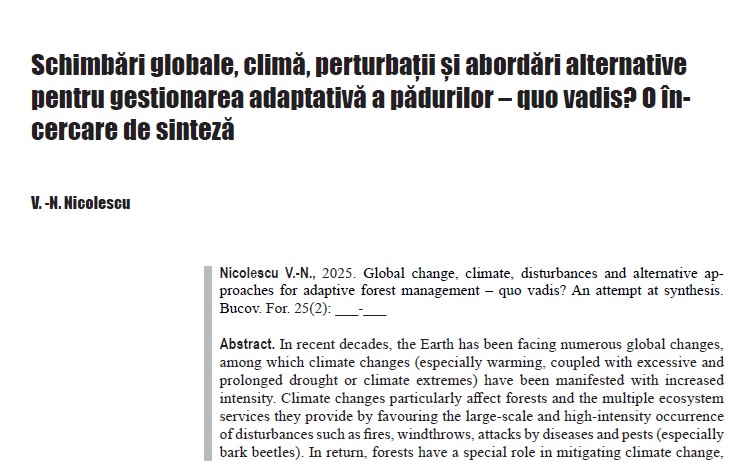
Schimbări globale, climă, perturbații și abordări alternative pentru gestionarea adaptativă a pădurilor – quo vadis? O încercare de sinteză
DOI:
https://doi.org/10.4316/bf.2025.014Cuvinte cheie:
climă, schimbări climatice, perturbații, adaptare, silvicultură apropiată de natură, management mai apropiat de natură al pădurilor, silvicultură cu acoperiș continuu, silvicultură inteligentă din punct de vedere climaticRezumat
În ultimele decenii, Terra se confruntă cu numeroase schimbări globale, între care cele climatice (mai ales încălzirea, cuplată cu seceta excesivă și prelungită ori extremele climatice) se manifestă cu o intensitate sporită. Schimbările climatice afectează în mod special pădurile și multiplele servicii ecosistemice pe care le asigură prin favorizarea producerii pe scară largă și cu intensități ridicate a perturbațiilor gen incendii, doborîturi de vânt, atacuri de boli și dăunători (mai ales gândaci de scoarță). În contrapartidă, pădurile au un rol deosebit în atenuarea schimbărilor climatice, prin sechestrarea și stocarea carbonului în lemnul, solul și litiera forestieră. Prin strategii adaptative active specifice, ecosistemele forestiere sunt gestionate durabil, cu precădere în scopul măririi rezilienței lor naturale la schimbări ale climei, în paralel cu conservarea biodiversității și menținerea potențialului lor de producătoare de lemn cu multiple utilizări. În acest context, articolul prezintă în detaliu atât componentele specifice ale strategiilor adaptative, cât și unele orientări moderne în gestiunea pădurilor, așa cum sunt silvicultura apropiată de natură, managementul mai apropiat de natură al pădurilor, silvicultura cu acoperiș continuu și silvicultura inteligentă din punct de vedere climatic.
Descărcări
Referințe
Académie des Sciences/Institut de France, 2023. Les forêts françaises face au changement climatique. Rapport du Comité des sciences de l’environnement de l’Académie des sciences et points de vue d’Académiciens de l’Académie d’Agriculture de France, juin 2013, Paris, 50 p.
Anonymous, 2008. Impacts of Climate Change on European Forests and Options for Adaptation. EFI-BOKU-IFE-INRA-UMR-IAFS, AGRI-2007-G4-06. Report to the European Commission Directorate-General for Agriculture and Rural Development, Bruxelles, 173 p.
Antonucci S., Santopuoli G., Marchetti M., Tognetti R., Chiavetta U., Garfì V., 2021. What Is Known About the Management of European Beech Forests Facing Climate Change? A Review. Current Forestry Reports 7:321–333. doi: 10.1007/s40725-021-00149-4
Barbu I., Curcă M., Barbu C., Ichim V., 2016. Adaptarea pădurilor României la schimbările climatice. Editura Silvică, Voluntari, 380 p.
Bolte A., Ammer C., Löf M., Madsen P., Nabuurs G-J., Schall P., Spathelf P., Rock J., 2009. Adaptive forest management in central Europe: Climate change impacts, strategies and integrative concept. Scandinavian Journal of Forest Research, 24(6): 473-482. doi: 10.1080/02827580903418224
Bolte A., Ammer C., Löf M., Madsen P., Nabuurs G-J., Schall P., Spathelf P., 2009. Adaptive Forest Management: A Prerequisitite for Sustainable Forestry in the Face of Climate Change. În: Sustainable Forest Management in a Changing World: a European Perspective (ed. P. Spathelf), Springer, Dordrecht-Heidelberg-London-New York, p. 115-140.
Bottero A., Forrester D.I., Cailleret M., Kohnle U., Gessler A., Michel D., Bose A.K., Bauhus J., Bugmann H., Cuntz M., Gillerot L., Hanewinkel M., Lévesque M., Ryder J., Sainte-Marie J., Schwarz J., Yousefpour R., Zamora-Pereira J.C., Rigling A., 2021. Growth resistance and resilience of mixed silver fir and Norway spruce forests in central Europe: Contrasting responses to mild and severe droughts. Global Change Biology, 27:4403–4419. doi: 10.1111/gcb.15737
Bowditch E., Santopuoli G., Binder F., del Río M., La Porta N., Kluvankova T., Lesinski J., Motta R., Pach M., Panzacchi P., Pretzsch H., Temperli C., Tonon G., Smith M., Velikova V., Weatherall A., Tognetti R., 2020. What is Climate-Smart Forestry? A definition from a multinational collaborative process focused on mountain regions of Europe. Ecosystem Services 32, 1011.13. doi: 10.1016/j.ecoser.2020.101113
Brack D., 2019. Forests and Climate Change. Background study prepared for the fourteenth session of the United Nations Forum on Forests. Forests and SDG13, March 2019, 56 p.
Brang P. Spathelf P., Larsen J.B., Bauhus J., Bončina A., Chauvin C., Drössler L., Garcıa-Güemes C., Heiri C., Kerr G., Lexer M.J., Mason B., Mohren F., Mühlethaler U., Nocentini S., Svoboda M., 2014. Suitability of close-to-nature silviculture for adapting temperate European forests to climate change. Forestry 87: 492–503, doi:10.1093/forestry/cpu018
Brichta J., Šimůnek V., Bílek L., Vacek Z., Gallo J., Drozdowski S., Bravo-Fernández J. A., Mason B., Roig Gomez S., Hájek V., Vacek S., Štícha V., Brabec P., Fuchs Z., 2024. Effects of Climate Change on Scots Pine (Pinus sylvestris L.) Growth across Europe: Decrease of Tree-Ring Fluctuation and Amplification of Climate Stress. Forests, 15(1), 91. doi: 10.3390/f15010091
Bus de Warnaffe G. du, Angerand S., 2020. Gestion forestière et changement climatique. Une nouvelle approche de la stratégie nationale d’atténuation. LIFE, Fédération des Amis de la Terre France, Canopée, Fern, Paris, 80 p.
Camill P., 2010. Global Change: An Overview. Nature Education Knowledge 3(10): 49. https://www.nature.com/scitable/knowledge/library/global-change-an-overview-13255365/
Carle H., Bauman D., Evans M.N., Coughlin I., Binks O., Ford A., Bradford M., Nicotra A., Murphy H., Meir P., 2025. Aboveground biomass in Australian tropical forests now a net carbon source. Nature, vol. 646, 10 October 2025, 611-618. doi: 10.1038/s41586-025-09497-8
Chambers J.Q., Nogueira Lima A.J., Pastorello G., Oliva Gimenez B., Meng L., Dyer L.A., Feng Y., Santos da Silva C., Costa de Oliveira R., Weber A., Koven C., Negrón-Juárez R., Spanner G.C., Gaui T.D., Fontes C.G., de Araújo A.C., McDowell N., Leung R., Magnabosco Marra D., Warren J., Souza D.C., Wright C., Jardine K., Longo M., Xu C., Fine P.V.A., Fisher R.A., Tomasella J., dos Santos J., Higuchi, N., 2025. Hot droughts in the Amazon provide a window to a future hypertropical climate. Nature, 10 December 2025. doi: 10.1038/s41586-025-09728-y
Chizmar S., Parajuli R., 2022. What is Climate Smart Forestry? A brief overview. NC State Extension Publications, Raleigh, 4 p.
Codul silvic – Legea 331/2024. Parlamentul României, Monitorul Oficial al României nr. 7 din 9 ianuarie 2025.
Coll L., Ameztegui A., Collet C., Löf M. Mason B., Pach M., Verheyen K., Abrudan I., Barbati A., Barreiro S., Bielak K., Bravo-Oviedo A., Ferrari B., Govedar Z., Kulhavy J., Lazdina D., Metslaid M., Mohren F., Pereira M., Peric S., Rasztovits E., Short I., Spathelf P., Sterba H., Stojanovic D., Valsta L, Zlatanov T., Ponette, Q., 2018. Knowledge gaps about mixed forests: what do European forest managers want to know and what answers can science provide? Forest Ecology and Management 407:106-115. doi: 10.1016/j.foreco.2017.10.055
Collalti A., Trotta C., Keenan T. F., Ibrom A., Bond-Lamberty B., Grote R., Vicca S., Reyer C.P.O., Migliavacca M., Veroustraete F., Anav A., Campioli M., Scoccimarro E., Šigut L., Grieco E., Cescatti A., Matteucci G., 2018. Thinning can reduce losses in carbon use efficiency and carbon stocks in managed forests under warmer climate. Journal of Advances in Modeling Earth Systems, 10, 2427–2452. doi: 10.1002/2018MS001275
Cooper L., MacFarlane D., 2023. Climate-Smart Forestry: Promise and risks for forests, society, and climate. PLOS Climate 2(6): e0000212, 26 p. doi: 10.1371/journal.pclm.0000212
C3S, WMO, 2025. European State of the Climate 2024. Copernicus Climate Change Service (C3S) and World Meteorological Organization, 99 p. climate.copernicus.eu/ESOTC/2024. doi: 10.24381/14j9-s541
Corona P., 2023. The Forest Factor Conference: More Nature to Fight Climate Change. IUFRO News, Vol. 52, Double Issue 7&8, p. 4.
Coșofreț C., Bouriaud L., 2019. Which silvicultural measures are recommended to adapt forests to climate change? A literature review. Bulletin of the Transilvania University of Brasov, Series II, Forestry-Wood Industry-Agricultural Food Engineering, 12(61):13-33. doi: 10.31926/but.fwiafe.2019.12.61.1.2
Čater M., Diaci J., 2021. Forest management silvicultural systems. In: Forests and forestry in Slovenia. Slovenian Forestry Institute, The Silva Slovenica Publishing Centre, Ljubljana, p. 36-53.
Dhubháin A.N., 2003. What is continuous cover forestry (CCF)? COFORD, Dublin, 6 p.
Drăcea M., 2020. Curs de Silvicultură 1920-1921. Editura Mirton, Timișoara (2018), 729 p.
EEA, 2024. European climate risk assessment. EEA Report 1/2024. European Environment Agency, Copenhagen, 486 pp. doi: 10.2800/8671471
Elkin C., Giuggiola A., Rigling A., Bugmann H., 2015. Short- and long-term efficacy of forest thinning to mitigate drought impacts in mountain forests in the European Alps. Ecological applications, Volume 25, Issue 4, pp. 1083-1098. doi: 10.1890/14-0690.1
EC, 2006. The EU Forest Action Plan 2007-2011. European Commission, Directorate-General for Agriculture and Rural Development, Bruxelles, 25 p.
Egger C., Grima N., Kleine M. Radosavljevic M. (eds.), 2024. Europe’s wood supply in disruptive times. An evidence-based synthesis report. IUFRO World Series, Volume 42, International Union of Forest Research Organizations, Vienna, 160 p.
English J., 2020. Spruce bark beetles and its impacts on wood marked. 9th June 2020. https://internationalforestindustries.com/2020/06/09/spruce-bark-beetle-impact-wood-markets/
European Commission, 2020. EU Biodiversity Strategy for 2030. Bringing nature back to our lives. European Commission, Brussels, 20.5.2020, COM(2020), 380 final, 22 p.
European Commission, 2021. New EU Forest Strategy for 2030. European Commission, Brussels, 16.7.2021, COM(2021), 572 final, 27 p.
European Commission, 2023. Guidelines on Closer-to-Nature Forest Management. Publications Office of the European Union, Luxembourg, 98 p.
FAO, 2025. Global Forest Resources Assessment 2025. FAO, Rome, 188 p. https://doi.org/10.4060/cd6709en
Fernández-de-Uña L., Cañellas I., Gea-Izquierdo G., 2015. Stand Competition Determines How Different Tree Species Will Cope with a Warming Climate. PLoS ONE 10(3): e0122255. doi: 10.1371/journal.pone.0122255
Fitzgerald J., Lindner M. (eds.), (2013) Adapting to climate change in European forests - Results of the MOTIVE project. Pensoft Publishers, Sofia, 108 p.
FOREST EUROPE, 2020a. State of Europe’s forests 2020. Ministerial Conference on the Protection of Forest in Europe – FOREST EUROPE, Liaison Unit Bratislava, 392 p.
FOREST EUROPE, 2020b. Adaptation to Climate Change in Sustainable Forest Management in Europe. Liaison Unit Bratislava, Zvolen, 52 p.
Forest Research, 2022. Forestry Statistics 2022. Chapter 1: Woodland Area & Planting. Forest Research, Roslin, 59 p.
Forest Research, 2025. Forestry Statistics 2025. Chapter 1: Woodland Area & Planting. Forest Research, Roslin, 80 p.
Ganatsas P., Tsakaldimi M., Karydopoulos T., Papaemannuil A., Papadopoulos S., 2024. Long-term effect of different forest thinning intensity on carbon sequestration rates and potential uses in climate change mitigation actions. Mitigation, Adaptation, and Strategies for Global Change, 29(3): 1-22. doi: 10.1007/s11027-023-10102-4
Gebhardt T., 2016. Picea abies and climate change – does increasing thinning intensity prevent drought stress? Waldbau und Waldökologie der Gemäßigten Zones, Georg-August-Universität Göttingen, Ph.D. Dissertation, Göttingen, 134 p.
Gohli J., Krokene P., Solbjørg Flo Heggem E., Økland B., 2024. Climatic and management-related drivers of endemic European spruce bark beetle populations in boreal forests. Journal of Applied Biology, 61: 809-820. doi: 10.1111/1365-2664.14606
Government of Ireland, 2023. Ireland’s National Forest Inventory 2022. Main Findings. Department of Agriculture, Food and the Marine, Government Publications, Dublin, 56 p.
Gregor K., Knoke T., Krause A., Reyer C.P.O., Lindeskog M., Papastefanou P., Smith B., Lansø A-S., Rammig A., 2022. Trade-offs for climate-smart forestry in Europe under uncertain future climate. Earth's Future, volume 10, issue 9, e2022EF002796, 1-25. doi: 10.1029/2022EF002796
Hilmers T., Schmied G., Pretzsch H., 2022. Legacy effects of past thinnings modulate drought stress reactions at present, Scandinavian Journal of Forest Research, 37(3): 182-199. doi: 10.1080/02827581.2022.2096920
Himes•A., Bauhus J., Adhikari S., Kanta Barik S., Brown H., Brunner A., Burton P.J., Coll L., D’Amato A.W., Diaci J., Dorji Y., Foli E.G., Ganz D.J., Hall J.S., Keenan R., Lu Y., Messier C., Munanura I., Piotto D., Seifert T., Sheil D., Shorohova E., Sisay K., Soto D., Tanaka H., Umunay P., Velázquez Martínez A., Puettmann K.J., 2023. Forestry in the Face of Global Change: Results of a Global Survey of Professionals. Current Forestry Reports, 9: 473-489. doi: 10.1007/s40725-023-00205-1
Hlásny T., Zimová S., Merganičová K., Štěpánek P., Modlinger R., Turčáni M., 2021. Devastating outbreak of bark beetles in the Czech Republic: Drivers, impacts, and management implications. Forest Ecology and Management, 490: 119075. doi: 10.1016/j.foreco.2021.119075.
Hörl J., Keller K,, Yousefpour R., 2020. Reviewing the performance of adaptive forest management strategies with robustness analysis. Forest Policy and Economics, 119: 102289. doi: 10.1016/j.forpol.2020.102289
INS, 2022. Anuarul statistic al României 2021. Institutul Național de Statistică, București, 745 p.
INS, 2024. Anuarul statistic al României 2023. Institutul Național de Statistică, București, 729 p.
INS, 2025. Anuarul statistic al României 2024. Institutul Național de Statistică, București, 725 p.
IPCC, 2023: Climate Change 2023: Synthesis Report. Contribution of Working Groups I, II and III to the Sixth Assessment Report of the Intergovernmental Panel on Climate Change [Core Writing Team, H. Lee and J. Romero (eds.)]. IPCC, Geneva, Switzerland, pp. 1-34, doi: 10.59327/IPCC/AR6-9789291691647.001
Jaakkola E., Gärtner A., Jönsson A.M., Ljung K., Olsson P-O., Holst T., 2023. Spruce bark beetles (Ips typographus) cause up to 700 times higher bark BVOC emission rates compared to healthy Norway spruce (Picea abies). Biogeosciences, 20: 803-826. doi: 10.5194/bg-20-803-2023
Jandl R., Spathelf P., Bolte A., Prescott C.E., 2019. Forest adaptation to climate change – is non-management an option? Annals of Forest Science, 76:48, 1-13. doi: 10.1007/s13595-019-0826-x
Janowiak M., Nagel L., Peterson C., 2023. What does adaptive silviculture look like? Yale Climate-Smart Forestry series, September 25, 2023, 35 slide-uri.
Ioniță M., Navagciuc V., 2025a. Temperatură și valuri de căldură în România. În: Starea climei – România 2025. Ediția a doua (ed. Cebotari, S., Roseti, A., Iosif, A.), Info Clima, București, 17 p.
Ioniță M., Nagavciuc V., 2025b. Secetă, aridizare și precipitații în România. În: Starea climei – România 2025. Ediția a doua (ed. Cebotari, S., Roseti, A., Iosif, A.), Info Clima, București, 16 p.
Kauppi P., Hanewinkel M., Lundmark T., Nabuurs G.J., Peltola H., Trasobares A., Hetemäki L., 2018. Climate smart forestry in Europe. European Forest Institute, Joensuu, 19 p.
Keeton W.S., McCallum S., Kuraś K., Fischer E., Egerer H., 2025. Assessment of climate risks and adaptation options for Carpathian forest ecosystems and their services. Secretariat of the Carpathian Convention, Vienna, Austria. 65 p.
Kohnle U., 2023. Durchforsten im Klimawandel – Risiko oder Prävention. Rheinische Bauernzeitung, 77 (9): 24-25.
Kolström M., Lindner M., Vilén T., Maroschek M., Seidl R., Lexer M.J., Netherer S., Kremer A., Delzon S., Barbati A., Marchetti M., Corona P., 2011. Reviewing the Science and Implementation of Climate Change Adaptation Measures in European Forestry. Forests 2, 961-982; doi:10.3390/f2040961
Larsen J.B., Angelstam P., Bauhus J., Carvalho J.F., Diaci J., Dobrowolska D., Gazda A., Gustafsson L., Krumm F., Knoke T., Konczal A., Kuuluvainen T., Mason B., Motta R., Pötzelsberger E., Rigling A., Schuck A., 2022. Closer-to- Nature Forest Management. From Science to Policy 12. European Forest Institute, 53 p. https://doi.org/10.36333/fs12
Lawrence A., 2017. Adapting through practice: Silviculture, innovation and forest governance for the age of extreme uncertainty. Forest Policy and Economics, 79: 50-60. doi: 10.1016/j.forpol.2016.07.011
Leuschner C., Weithmann G., Bat-Enerel B., Weigel R., 2023. The Future of European Beech in Northern Germany-Climate Change Vulnerability and Adaptation Potential. Forests, 14, 1448: 1-22. doi: 10.3390/f14071448
Lindner M., 2000. Developing adaptive forest management strategies to cope with climate change. Tree Physiology, 20: 299-307.
Lindner M., 2019. Climate Change and Adaptation Challenge. Forest Europe Workshop “Pro-active management of forests to combat climate change driven risks – Policies and measures for increasing forest resilience and climate change adaptation”, 3-4 September 2019, Istanbul, Turkey, 13 slide-uri.
Lindner M., Maroschek M., Netherer S., Kremer A., Barbati A., Garcia-Gonzalo J., Seidl R., Delzon S, Corona P., Kolström M., Lexer M.J., Marchetti M., 2010. Climate change impacts, adaptive capacity, and vulnerability of European forest ecosystems. Forest Ecology and Management, 259: 698-709. doi: 10.1016/j.foreco.2009.09.023
Lindner M., Kies U., Viljanen A., Lloret F., Ludvig A., Cantarello E., Seidl R., Stern T., Nabuurs G-J., Toppinen A., Schifferdecker G., Alonso Martínez L., Bauhus J., Baumbach L., Bozzolan N., D'Adamo F., Espelta J.M., García Jácome S., Grünig M., Hagauer D., Hlásny T., Hoeben A.D., Holder J., Jankovský M., Kičić M., Kunstler G., Kunttu J., Lautrup M., Mäkelä A., Martínez Vilalta Ostrogović J., Patacca M., Pelli P., Peltoniemi M., Picos J., Rammer W., Reineking B., Rois-Díaz M., Schmid B., Senf C., Short I., Spazzi J., Uzquiano S., Vuletić D., Whitehead I., Willig, J., 2025. Deliverable D5.6. Policy and practice recommendations for improving forest resilience. Horizon 2020 project RESONATE, grant no. 101000574, European Forest Institute and University of Helsinki. https://doi.org/10.5281/zenodo.15252633
Locatelli T., 2025. How to windstorms affect forests in Europe? https://efi.int/forestquestions/q26
Mason B., 2021. Encouraging Greater Use of Continuous Cover Forestry. Quarterly Journal of Forestry, 115(1): 46-54.
Mason B., Kerr G., Simpson J., 1999. What is Continous Cover Forestry? Forestry Commission, Edinburgh, 8 p.
Mason W.L., Petr M., Bathgate S., 2012. Silvicultural strategies for adapting planted forests to climate change: from theory to practice. Journal of Forest Science, 58(6): 265–277. doi: 10.17221/105/2011-JFS
Mason W.L., Diaci J., Carvalho J., Valkonen S., 2021. Continuous cover forestry in Europe: usage and the knowledge gaps and challenges to wider adoption. Forestry, 95: 1–12. doi: 10.1093/forestry/cpab038.
Mattsson B.J., Irauschek F., Yousefpour R., 2018. Gaps in Quantitative Decision Support to Inform Adaptive Management and Learning: a Review of Forest Management Cases. Current Forestry Reports, 4: 111-124. doi: 10.1007/s40725-018-0078-3
McMahon P., Sarshar D., 2025. Investing in Continuous Cover Forestry in Europe. SLM White Paper, Sustainable Land Management Partners, London, 31 p.
McNee J., 2020. Spruce bark beetle’s devastating impact on German forests. 10th October 2020. https://www.forestryjournal.co.uk/features/18766981.fighting-losing-battle/
Messier C., Bauhus J., Doyon F., Maure F., Sousa-Silva R., Nolet P., Mina M., Aquilué N., Fortin M.J., Puettmann K., 2019. The functional complex network approach to foster forest resilience to global changes. Forest Ecosystems, 6: 21, 1-16. doi: 10.1186/s40663-019-0166-2
Messier C., Potvin C., Muys B., Brancalion P., Chazdon R., Seidl R., Bauhus J., 2022. Warning: Natural and Managed Forests are Losing their Capacity to Mitigate Climate Change. The Forestry Chronicle, 98(1): 2-3. doi: 10.5558/tfc2022-007
Millar C.I., Stephenson N.L., Stephens S.L., 2008. Reframing Forest and Resource Management Strategies for a Climate Change Context. US Department of Agriculture, Forest Service, Climate Change Resource Center, 7 p. http://www.extension.org/pages/33378/adaptive-forest-management-strategies
Moreau G., Chagnon C., Achim A., Caspersen J., D’Orangeville L., Sánchez-Pinillos M., Thiffault, N., 2022. Opportunities and limitations of thinning to increase resistance and resilience of trees and forests to global change. Forestry, 95(5): 595-615. doi: 10.1093/forestry/cpac010
Nabuurs G.J., Verkerk P.J., Schelhaas M.J., González Olabarria J.R., Trasobares A., Cienciala E., 2018. Climate-Smart Forestry: mitigation impacts in three European regions. From Science to Policy 6. European Forest Institute, Joensuu, 30 p.
Navarro-Cerrillo R.M., Sánchez Salguero R., Rodriguez C., Duque Lazo J., Moreno-Rojas J.M., Palacios-Rodriguez G., Camarero J.J., 2019. Is thinning an alternative when trees could die in response to drought? The case of planted Pinus nigra and P. sylvestris stands in southern Spain. Forest Ecology and Management, 433: 313-324. doi: 10.1016/j.foreco.2018.11.006.
Navarro-Cerrillo R.M., Cachinero-Vivar A.M., Pérez-Priego O., Aspizua Cantón R., Begueria S., Camarero J.J., 2023. Developing alternatives to adaptive silviculture: Thinning and tree growth resistance to drought in a Pinus species on an elevated gradient in Southern Spain. Forest Ecology and Management, 537: 120936. doi: 10.1016/j.foreco.2023.120936
Nocentini S., Buttoud G., Ciancio O., Corona P., 2017. Managing forests in a changing world: the need for a systematic approach. A review. Forest Systems 26(1): 1-16. doi: 10.5424/fs/2017261-09443
O’Hara K.L., 2016. What is close-to-nature silviculture in a changing world? Forestry - An International Journal of Forest Research, 89: 1–6. doi:10.1093/forestry/cpv043.
Park A., Puettmann K., Wilson E., Messier C., Kames S., Dhar A., 2014. Can Boreal and Temperate Forest Management be adapted to the Uncertainties of 21st Century Climate Change? Critical Reviews in Plant Sciences, 33: 251-285. doi: 10.1080/07352689.2014.858956
Pretzsch H., Zenner E.K. 2017. Toward managing mixed-species stands: from parametrization to prescription. Forest Ecosystems, 4(19): 1-17. doi: 10.1186/s40663-017-0105-z
Pro Silva, 2012. Pro Silva Principles. English - Français – Deutsch. Pro Silva, Zürich, 67 p.
Puettmann K.J., 2014. Silviculture to enhance the adaptive capacity of forests. Proceedings of the second International Congress of Silviculture, Florence, November 26th - 29th 2014, pp. 1157-1161.
Puettmann K.J., Wilson S.Mc.G., Baker S.C., Donoso P.J., Drössler L., Amente G., Harvey B.D., Knoke T., Lu Y., Nocentini S., Putz F.E., Yoshida T., Bauhus J., 2015 Silvicultural alternatives to conventional even-aged forest management - what limits global adoption? Forest Ecosystems, 2:8: 1-16. doi: 10.1186/s40663-015-0031-x
Reyer C.P.O., Bugmann H., Nabuurs G.J., Hanewinkel M., 2015. Models for adaptive forest management. Regional Environmental Change, 15: 1483-1487. doi: 10.1007/s10113-015-0861-7
Río M. del, Pretzsch H., Alberdi I., Bielak K., Bravo F., Brunner A., Condés S., Ducey M.J., Fonseca T., von Lüpke N., Pach M., Peric S., Perot T., Souidi Z., Spathelf P., Sterba H., Tijardovic M., Tomé M., Vallet P., Bravo-Oviedo A., 2016. Characterization of the structure, dynamics, and productivity of mixed-species stands: review and perspectives. European Journal of Forest Research, 135: 23-29. doi: 10.1007/s10342-015-0927-6
Rist L., Felton A., Marald E., Samuelsson L., Lundmark T., Rosvall O., 2016. Avoiding the pitfalls of adaptive management implementation in Swedish silviculture. Ambio 45(Suppl. 2): S140–S151. doi: 10.1007/s13280-015-0750-9
Romagnoli F.,Cadei A., Costa M., Marangon D., Pellegrini G., Nardi D., Masiero M., Secco L., Grigolato S., Lingua E., Picco L., Pirotti F., Battisti A., Locatelli T., Blennow K., Gardiner B., Cavalli R., 2023. TAMM Review: Wind storm impacts on European forest-related systems: An interdisciplinary perspective. Forest Ecology and Management, 541: 121048, 1-12. doi: 10.1016/j.foreco.2023.121048
Rukh S., Sanders T.G.M., Krüger I., Schad T., Bolte A., 2023. Distinct Responses of European Beech (Fagus sylvatica L.) to Drought Intensity and Length—A Review of the Impacts of the 2003 and 2018–2019 Drought Events in Central Europe. Forests, 14, 248: 1-24. doi: 10.3390/f14020248
San-Miguel-Ayanz J., de Rigo D., Caudullo G., Houston Durrant T., Mauri A. (ed.), 2016. European Atlas of Forest Tree Species. Publication Office of the European Union, Luxembourg. doi: 10.2788/038466
Sanginés de Cárcer P., Mederski P.S., Magagnotti M., Spinelli R., Engler B., Seidl R., Eriksson A., Eggers J., Gallus Bont L., Schweier J., 2022. The Management Response to Wind Disturbances in European Forests. Current Forestry Reports, 7:167–180. doi: 10.1007/s40725-021-00144-9
Sankey T., Tatum J., 2022. Thinning increases forest resiliency during unprecedented drought. Scientific Reports, 12: 9041: 1-11. doi: 10.1038/s41598-022-12982-z
Schmied G., Pretzsch H., Ambs D., Uhl E., Schmucker J., Fäth J., Biber P., Hoffmann Y-D., Šeho M., Mellert K.H., Hilmers T., 2023. Rapid beech decline under recurrent drought stress: Individual neighborhood structure and soil properties matter. Forest Ecology and Management, 545, 121305: 1-16. doi: 10.1016/j.foreco.2023.121305
Schmitt A., Trouvé R., Seynave I., Lebourgeois,F., 2020. Decreasing stand density favors resistance, resilience, and recovery of Quercus petraea trees to a severe drought, particularly on dry sites. Annals of Forest Science, 77: 52. doi: 10.1007/s13595-020-00959-9
Sohn J.A., Hartig F., Kohler M., Huss J., Bauhus J., 2016. Heavy and frequent thinning promotes drought adaptation in Pinus sylvestris forests. Ecological applications, 26(7): 2190-2205. doi: 10.1002/eap.1373
Spathelf P., 2019. Potential adaptation options for increasing the resilience of forests in the view of the projected impacts of climate change. Forest Europe Workshop “Pro-active management of forests to combat climate change driven risks – Policies and measures for increasing forest resilience and climate change adaptation”, 3-4 September 2019, Istanbul, Turkey, 37 slide-uri.
Spathelf P., Bolte A., van der Maaten E., 2015. Is Close-to-Nature Silviculture (CNS) an adequate concept to adapt forest to climate change? Landbauforsch (Applied Agricultural Forestry Research), 65(3/4): 161-170. doi: 10.3220/LBF1452526188000
Spathelf P., Stanturf J., Kleine M., Jandl R., Chiatante D., Bolte A., 2018. Adaptive measures: integrating adaptive forest management and forest landscape restoration. Annals of Forest Science, 75(55): 1-6. doi: 10.1007/s13595-018-0736-4
Steckel M., Moser W., Rio, M. del, Pretzsch H. 2020. Implications of Reduced Stand Density on Tree Growth and Drought Susceptibility: A Study of Three Species under Varying Climate. Forests, 11, 627: 1-26. doi: 10.3390/f11060627
Stritih A., Lecina-Diaz J., Mohr J., Schattenberg C., Ammer C., Anselmetto N., Bauhus J., Bončina A., Garbarino M., Hlásny T., Lindner M., Lingua E., Knific E., Krüger K., Marangon D., Morresi D., Mulec K., Nagel T.A., Potterf M., Stritih J., Thom D., Welling D., Seidl R., 2026. Can “Closer-to-Nature” Forest Management Sustain Biodiversity and Ecosystem Services in an Uncertain Future? Lessons from Central Europe. Current Forestry Reports, 12(1): 1-21. doi: 10.1007/s40725-025-00264-6.
Štefančik I., Vacek Z., Sharma R.P., Vacek S., Rösslová M. 2018. Effect of thinning on growth and development of crop trees in Fagus sylvatica stands of Central Europe over fifty years. Dendrobiology, 79: 141-155. doi: 10.12657/denbio.079.013
Taccoen A., Piedallu C., Seynave I., Gégout-Petit A., Nageleisen L.M., Bréda N., Gégout J-C., 2021. Climate change impact on tree mortality differs with tree social status. Forest Ecology and Management, 489: 119048. doi: 10.1016/j.foreco.2021.119048
Taylor B., Kremsater L., Ellis R., 1997. Adaptive management of forests in British Columbia. British Columbia Ministry of Forests, Forest Practices Branch, Victoria, 87 p.
Temperli C., Bugmann H., Elkin C., 2012. Adaptive management for competing forest goods and services under climate change. Ecological Applications, 22(8): 2065-2077. doi: 10.1890/12-0210.1
Thiffault N., Raymond P., Lussier J.M., Aubin I., Royer-Tardif S., D’Amato A.W., Doyon F., Lafleur B., Perron M., Bousquet J., Isabel N., Carles S., Lupien P., Malenfant A., 2021. Adaptive Silviculture for Climate Change: From Concepts to Reality. Report on a symposium held at Carrefour Forêts 2019. The Forestry Chronicle, 97(1): 13-27. doi: 10.5558/tfc2021-004
Thom D., 2023. Natural disturbances as drivers of tipping points in forest ecosystems under climate change – implications for adaptive management. Forestry: An International Journal of Forest Research, 96(3): 305–315. doi: 10.1093/forestry/cpad011
Vítková L., Dhubháin, A.N., 2013. Transformation to continuous cover forestry: a review. Irish Forestry, 70: 119-140.
Vítková L., Dhubháin Á.N.., Tuama O.P., Purser P., 2013. The practice of continuous cover forestry in Ireland. Irish Forestry 70: 141–156.
Weatherall A., Nabuurs G-J., VelikovaV., Santopuoli G., Neroj B., Bowditch E., Temperli C., Binder F., Ditmarová L., Jamnická G., Lesinski J., La Porta N., Pach M., Panzacchi P., Sarginci M., Serengil Y., Tognetti R., 2022. Defining Climate-Smart Forestry. In: Tognetti, R., Smith, M., Panzacchi, P. (ed): Climate-Smart Forestry in Mountain Regions, Managing Forest Ecosystems 40, 35-58. https://doi.org/10.1007/978-3-030-80767-2_2
Willig J., Schwarz J., Comeau Ph., Hartmann H., Kohnle U., Espelta J.M., Makinen H., Ogaya R., Peltoniemi M., Penuelas J., Roth B., Ruiz‑Peinado R., Ruge F., Bauhus J., 2025. No increased drought‑related mortality after thinning: a meta‑analysis. Annals of Forest Science, 82(6): 1-25. doi: 10.1186/s13595-025-01278-7
Surse electronice
https://www.forestresearch.gov.uk/research/human-dimensions-of-adaptive-forest-management/ (accesat 25 decembrie 2025)
https://forest.jrc.ec.europa.eu/en/activities/forests-and-climate-change/ (accesat 15 octombrie 2025)
https://www.forestry.org.au/media-release-next-government-must-prioritise-active-and-adaptive-forest-management/ (accesat 25 mai 2023)
https://www.climatesmartforestry.org/ (accesat 20 decembrie 2025)
https://www.okelly.se/bark-beetle/ (accesat 23 decembrie 2025)
https://www.agci.org/what-is-global-change (accesat 4 ianuarie 2026)
https://adria-balkan.fsc.org/en/forest-ecosystems/forests-in-slovenia (accesat 22 decembrie 2025)
Descărcări
Publicat
Cum cităm
Număr
Secțiune
Licență
Copyright (c) 2025 Valeriu-Norocel Nicolescu

Această lucrare este licențiată în temeiul Creative Commons Attribution-NonCommercial 4.0 International License.
Licența Open Access
Toate articolele și materialele suplimentare publicate în revista BUCOVINA FORESTIERĂ sunt disponibile sub o politică de acces liber gratuit (Open Access Licence) descrisă de BOAI, ceea ce implică accesul liber (fără nici o taxă) și nelimitat, pentru toată lumea, la conținutul integral al acestora.
Publicarea manuscriselor este gratuită, toate cheltuielile fiind suportate de către Facultatea de Silvicultură din cadrul Universități „Ștefan cel Mare” din Suceava.